
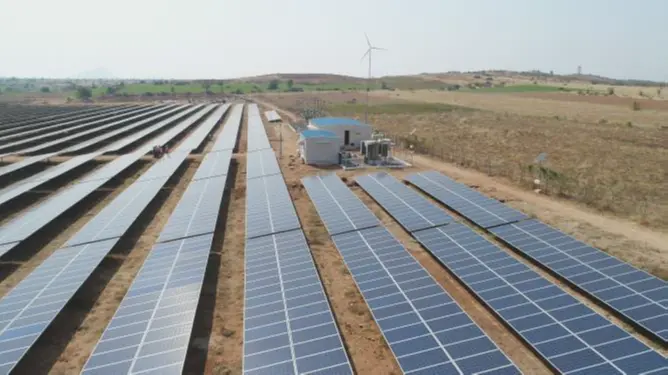
Downing Andhra Project: Transaction Advisory for a 10.9 MWp Solar Investment Opportunity
Project Overview
The Downing Andhra Project was a 10.9 MWp solar PV plant located in Anantapur District, Andhra Pradesh. The asset had achieved commercial operation in March 2017 and was structured as a third-party open access solar project supplying power to commercial and industrial customers.
The seller was a global infrastructure fund looking to divest the project as part of a wider portfolio restructuring exercise. For any potential buyer or investor, the opportunity required more than a high-level review of capacity, tariff, and location. It needed an independent assessment of the asset’s technical quality, commercial structure, open access position, land status, and long-term operating potential.
This is where SunDesh’s role as an independent third-party assessment and transaction advisory partner became important.
The Client Context
Renewable energy investors and industrial buyers often evaluate operating assets for acquisition, long-term procurement, or portfolio expansion. These assets may look attractive because they are already commissioned and generating power, but the real value depends on the strength of the underlying project.
In this case, the project had several relevant features: a 10.9 MWp operating solar plant, owned private land, third-party open access structure, private PPAs with three C&I customers, and a tariff range of ₹3.4–₹3.9 per kWh. The project’s Long-Term Open Access approval was valid until June 2027, with a possibility of extension by two years.
While these details made the opportunity commercially interesting, they also required careful validation. A buyer needed to understand not just what the project claimed on paper, but what risks, obligations, and improvement opportunities existed beneath the surface.
The Challenge
The main challenge in any operating renewable asset transaction is clarity.
A solar plant may have commissioned capacity, PPAs, land, generation estimates, and equipment details. But investors still need answers to important questions:
- Is the asset technically reliable?
- Are the modules, inverters, mounting structures, and BoP systems in acceptable condition?
- Is the land ownership clear and transaction-ready?
- Are the PPAs commercially strong and enforceable?
- Is the tariff attractive in the current power market?
- What are the risks around open access continuity?
- Are there O&M gaps that could affect future performance?
- Does the financial model reflect realistic generation and operating assumptions?
For the Downing Andhra Project, SunDesh’s role was to help evaluate the opportunity across these dimensions and support informed decision-making.
SunDesh’s Advisory Role
SunDesh approached the project as an independent third-party advisor. The focus was not on selling the asset or operating it, but on assessing its attractiveness, identifying risks, and supporting the transaction process with technical and commercial insight.
The advisory scope covered three broad stages: deal review, due diligence, and transaction support.
Deal review
SunDesh assessed the investment memorandum, asset profile, location, solar resource, PPA structure, tariff range, open access arrangement, and seller background. This helped establish whether the opportunity was worth deeper evaluation.
Due diligence
SunDesh’s assessment framework covered technical, commercial, legal, operational, and process-related areas. This included reviewing plant and BoP reliability, O&M gaps, asset life, contractual commitments, financial model assumptions, site conditions, and stakeholder dependencies.
Transaction support
SunDesh’s role extended to asset improvement planning, yield optimisation planning, contract review, valuation support, negotiation inputs, governance design, and asset takeover planning.
What SunDesh Assessed
For an operating solar project, SunDesh’s assessment went beyond headline capacity and generation estimates.
The project had ReneSola modules, Ingeteam inverters, a concrete pile foundation mounting structure, and sub-contracted O&M. Annual generation was estimated at 1,77,34,300 units as per the PVsyst report. These details provided the technical starting point for evaluation.
However, SunDesh’s role was to assess whether the project could deliver reliable long-term value. This meant assessing the quality of the physical asset, the strength of the commercial contracts, the open-access validity period, the O&M structure, and the scope for future improvement.
The objective was to help the client see the project clearly: its strengths, risks, dependencies, and post-acquisition priorities.
Why Independent Assessment Matters
Operating renewable assets are increasingly becoming part of India’s secondary transaction market. Investors, funds, developers, and industrial buyers are evaluating solar and wind assets that have already been commissioned and have existing contracts in place.
However, these opportunities can be complex. A plant may appear attractive because it has operational history and signed PPAs, but hidden risks can exist in equipment condition, grid approvals, land documentation, O&M quality, generation assumptions, regulatory exposure, or customer offtake arrangements.
An independent third-party assessment helps reduce this uncertainty. It brings technical discipline, commercial objectivity, and transaction experience into the decision-making process.
For buyers, this means better risk visibility. For sellers, it helps position the asset more clearly. For investors, it supports stronger valuation, negotiation, and post-acquisition planning.
Why This Case Matters
The Downing Andhra Project is a strong example of SunDesh’s transaction advisory capability in renewable energy.
SunDesh was able to bring together asset understanding, power market context, due diligence discipline, and transaction support into a structured advisory framework. This helped convert a project teaser into a more informed investment opportunity.
The case also shows why renewable energy transactions need specialist assessment. Solar projects are not evaluated only by capacity or tariff. They must be reviewed as operating infrastructure assets, where performance, contracts, land, approvals, technology, O&M, and future risks all influence value.
FAQs
No FAQs found.